
Some books don’t try to teach you something new.
They quietly rearrange how you see what you thought you already understood.
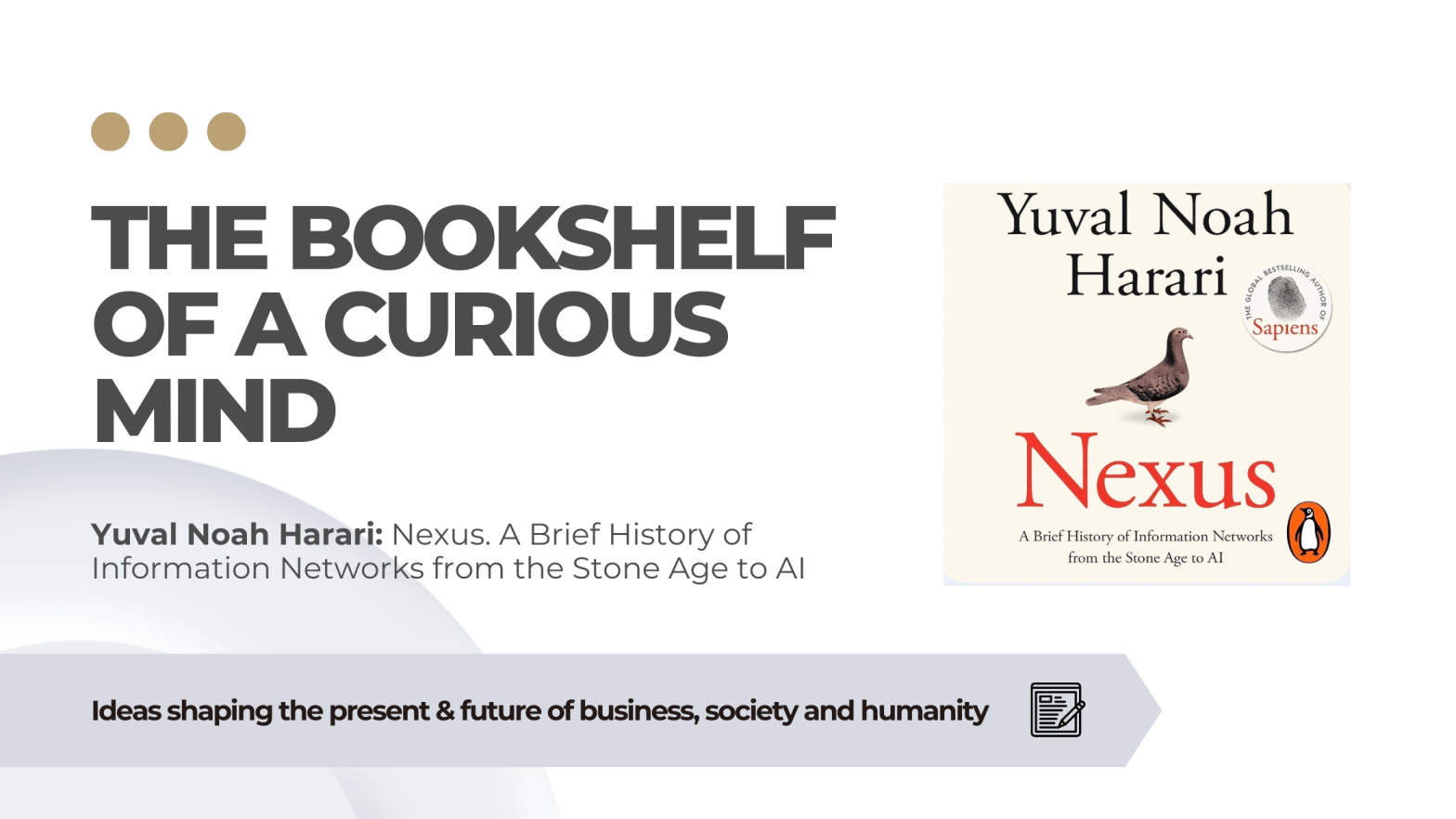
Nexus by Yuval Noah Harari is one of those books for me.
I picked it up out of the same curiosity that has taken me to many places around the world: a desire to understand how humans make sense of the world, and how we manage to move together, despite everything that pulls us apart.
Learning was never just about knowing
One idea kept circling back in the book: information networks didn’t survive because they were true. They survived because they helped humans coordinate.
Stories. Myths. Belief systems. Bureaucracies. Money.
None of these are neutral containers of truth as Harari explains. They are agreements. In other words – shared narratives that allow millions of strangers to act as if they’re part of the same story.
I had to pause on this thought.
So much of modern learning, especially in professional and organisational contexts, is framed as knowledge transfer. Skills to acquire. Content to consume. Competencies to tick off.
But if Harari is right, then learning has always been something else entirely: a way of aligning minds, behaviours, and expectations.
Perhaps that’s why so many learning experiences feel unsatisfying. They inform, but they don’t orient. They tell, but they don’t engage.
When information runs faster than understanding
Another thought that stayed with me was slightly heavier.
Information networks, Harari shows, tend to scale faster than our ability to interpret them wisely. This isn’t new. It has happened before, many times. But AI accelerates this gap to a pace that feels… dizzying.
We talk about upskilling as if speed were the virtue: faster learning, faster adaptation, faster deployment. More courses. Shorter modules. Continuous everything.
But reading Nexus, I found myself wondering whether learning design has been borrowing too eagerly from the logic of the technologies it responds to.
What if the real challenge now isn’t access to information, but the cultivation of judgment? What if learning needs less acceleration and more gravity?
Moments that slow us down. Invite reflection. Allow uncertainty. Help us integrate rather than accumulate.
What I’m taking away
Nexus offers perspective. A long view of who we are and where we are heading.
It reminded me that learning is not a product, nor a pipeline, nor a platform feature. It is a deeply human act, shaped by the stories we inherit, the systems we trust, and the meanings we agree to carry together.
Standing at the edge of yet another technological shift, that felt like a useful thing to remember.
If you’ve read Nexus, leave a comment below. I’d love to know what stayed with you.
 Gabriella Ferenczi