
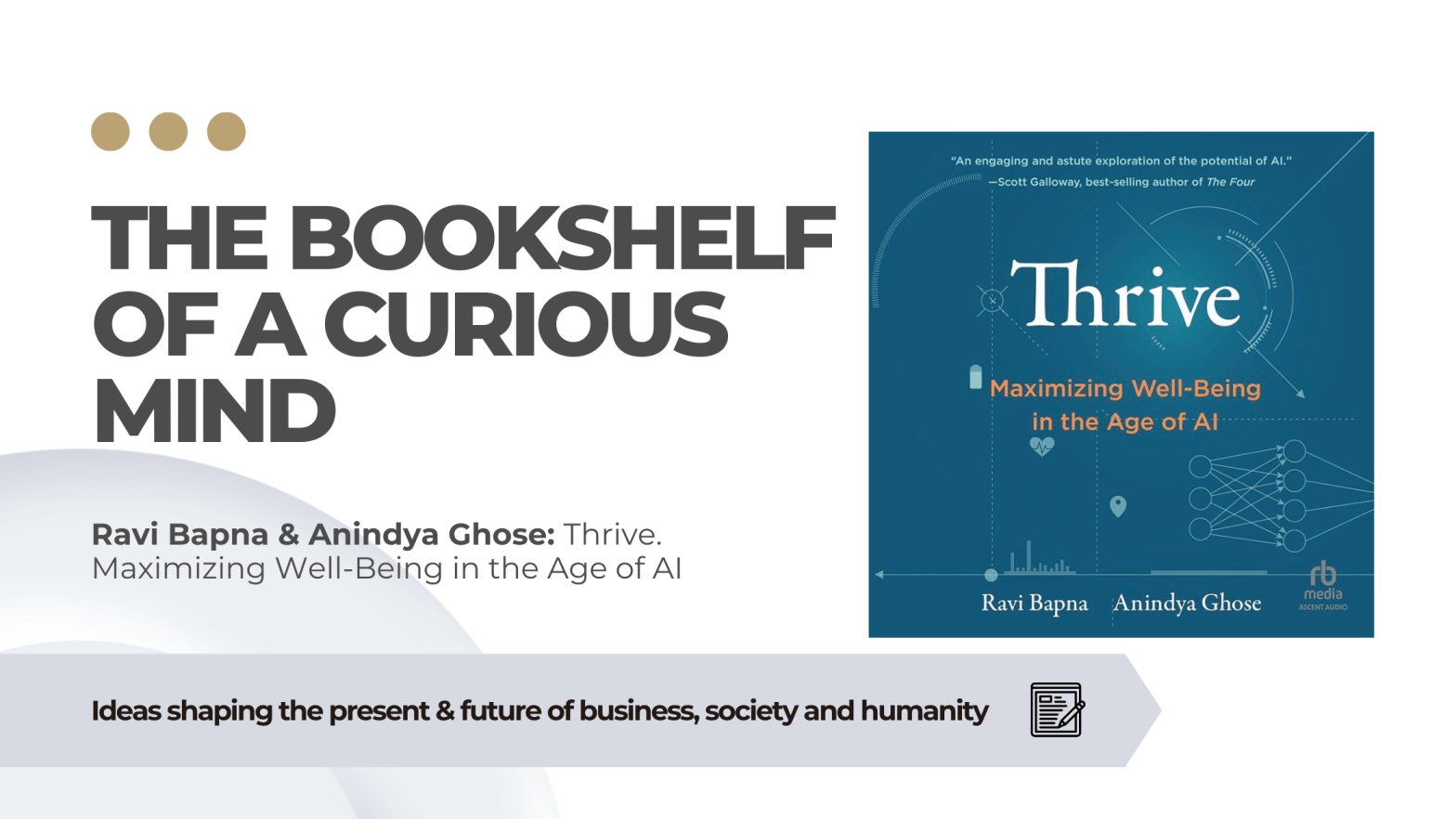
I’ll start with a small warning: the title is misleading.
Thrive. Maximizing Well-Being in the Age of AI by Ravi Bapna and Anindya Ghose is not a wellness book. There are no lifestyle prescriptions here, no productivity and self-care rituals. What the authors are really interested in is something more structural: how AI creates value in society and organisations – and what humans need to learn in order to stay oriented within that shift.
One of the ideas that helps us think more clearly about this is what they call the House of AI.
The House of AI
The book offers a grounded way of understanding what AI actually does for most people.
Much of AI’s value, they argue, comes from machine learning, and within that sit four foundational pillars:
- Descriptive analytics – what happened
- Predictive analytics – what might happen
- Causal analytics – why it happened
- Prescriptive analytics – what should be done next
These pillars power everything from recommendation systems to health apps, hiring tools, and decision-support systems. They sit on a foundation of data engineering (cleaning, integrating, transforming, and maintaining data) so that any of the above is even possible.
I liked this framing because it quietly de-mystifies AI. It moves the conversation away from hype and towards capability. And then, once that house is sketched, the authors shift metaphors entirely.
They invite us to think of AI adoption as climbing Everest.
Base camp: the why question
The climb starts at base camp.
Here, leaders are not choosing tools as the authors explain. They are answering a much harder question: why AI?
What problems are worth solving? Where should humans focus their attention? How do we keep our most productive resource – human capital – on the efficient frontier of decision-making?
The Everest metaphor resonated, big time.
I’ve been to the higher Himalayas. I’ve been to Everest Base Camp. And while I never even contemplated a summit, I know exactly what the base camp represents. It’s a place where you acclimatise. You plan. You listen. You don’t rush – because if you do, the mountain will deal with that later.
The authors’ point is similar: miss the why, and everything that follows becomes fragile.
Camp 1: the Khumbu Icefall of data
From base camp, the route immediately turns technical. The authors continue with the Everest metaphor.
If data is the new oil, then data engineering is the new core competence – and this is Camp 1, the Khumbu Icefall. Treacherous, but unavoidablel. Data must be collected, cleaned, aggregated, integrated, transformed.
There is nothing glamorous about this stage, but without it, there is no ascent.
Reading this, I couldn’t help thinking about learning initiatives that skip foundations in favour of speed, eg. advanced tools without shared literacy, strategy without infrastructure.
The icefall always catches up with you.
Camp 2: using the House of AI
Only after this do we meaningfully engage with the four pillars of the House of AI: descriptive, predictive, causal, prescriptive.
This is where organisations begin to ask better questions of their data, and of their systems. Not just what happened or what might happen, but why and what should we do about it.
For learning and upskilling, it’s important to note that understanding AI isn’t about mastering one tool. It’s about knowing which kind of question you’re actually asking, and which level of insight it requires.
Camp 3 and the summit: leadership, not technology
Higher up the mountain, things thin out. Deep learning. Reinforcement learning. Generative AI. More complex use cases, higher stakes.
But the summit, the authors are clear, is not technical.
The real ascent lies in AI leadership and organisational capability: managing culture change, building trust, augmenting human judgment with AI inputs rather than replacing it. Creating an AI-ready workforce. Bringing people along.
Just like Everest, no one reaches the summit alone. You need a team. You need coordination. You need experience, humility, and shared intent.
My takeaway
AI adoption is not a sprint. It’s an expedition. Learning, therefore, is about staying oriented and ethical on the climb, and not just simply about trying to keep up.
Your thoughts? Do leave a comment below.
 Gabriella Ferenczi