

The mind creates the abyss. The heart crosses it.
– Sri Nisargadatta Maharaj
It was the summer of 2023. I remember reading Lynne Twist’s brilliant books, The Soul of Money first, followed by Living a Committed Life. Twist, a renowned activist and fundraiser recounts several stories of her life, including working for The Hunger Project, and how she ended up as a founding member of the Pachamama Alliance. This sent me down a rabbit hole of looking into this organisation. I found out that the Pachamama Alliance and the Fundacion Pachamama established connections with indigenous tribes in the Sacred Headwaters Region of the Amazonian rainforest and that they organise journeys, allowing visitors to meet the indigenous caretakers of the rainforest. Through these journeys, people can form personal partnerships with them, thereby supporting them in their efforts to protect their land and people against extractive industries like mining and logging.
I immediately felt the calling in my heart. It had been four years since our last adventure in the higher Himalayas of Nepal and Tibet. Indigenous wisdom keepers have fascinated me for a long time and I wrote a few early posts on why I believe we, the inhabitants of the modern world have so much to learn from them:
Coming across Lynne Twist’s book and reading about the Achuar tribe was a sign that it was time for another trip.
You know the kind of feeling that is so visceral you can’t stop thinking about it? That’s exactly what I felt. I started to dream about the journey. I watched every available documentary on Amazonia. I read books on Ecuador, listened to and watched everything about the jungle, indigenous tribes, their culture and way of living. It was crystal clear that I just couldn’t let the idea go.
Before I knew it, discovery Zoom call was booked, and the journey for January 2024 was reserved.
My husband kept reminding me of the ‘jaguar clause’ of our contract, something along the lines of:
‘If you don’t follow your guide’s instructions and you’re eaten by a jaguar, the organisation won’t be liable.’ You sure you’re ok with that? – he asked.
‘I’m as sure as I’ll ever be’ was my response.
And with that, a 6-month long preparation went into full swing.
Gearing Up for an Off-The-Grid Experience in the Rainforest
Travelling to the other side of the world, into a place this remote requires a thorough preparation both mentally, physically and equipment-wise.
We were due to leave London on New Year’s Eve 2023.
To limit exposure to all sorts of germs during the Christmas season, we didn’t visit our families in Europe – especially as at the time, winter flu and a new season of COVID were on the rise. The last thing one wants ahead of such a journey is an illness. Thankfully, our families were understanding.
So, we hunkered down in our small London apartment, and prepped meticulously, following the instructions of our tour info pack.
- Moisture wicking, synthetic or lightweight clothing – tick. We opted for items that covered our skin from top to bottom for extra protection against insects and mosquitos.
- Poncho, head torch, waterproof ziploc bag for camera/phone – tick.
- Biodegradable cosmetics, sun protection, mosquito and insect repellent – tick. (It’s important not to leave any rubbish behind that’s not biodegradable. The last thing you want to do is polluting what’s left of this pristine paradise.)
- Lightweight sun hat – tick.
- Sunglasses strap so we won’t lose it in the canoe – tick.
- Vaccinations – tick.
Jungle Health & Safety
The rainforest region we visited does have a history of malaria so preventative medicine was recommended, but I’m always very careful about taking medications as I tend to get all the unwanted side effects. In a remote place with no medical infrastructure, I didn’t want to risk taking medicine I’d never taken before. But at the same time, of course, I didn’t want to compromise our health and safety. Dilemma, dilemma …
After doing some extensive research and thorough consultation with our travel nurse, we opted for skin protection from top to bottom, covering every inch of our skin with light clothing AND mosquito repellent to protect from malaria. (Spoiler: nothing could stop insects from getting to us, our skin was covered in bites from day one.)
Balancing Needs and Weight
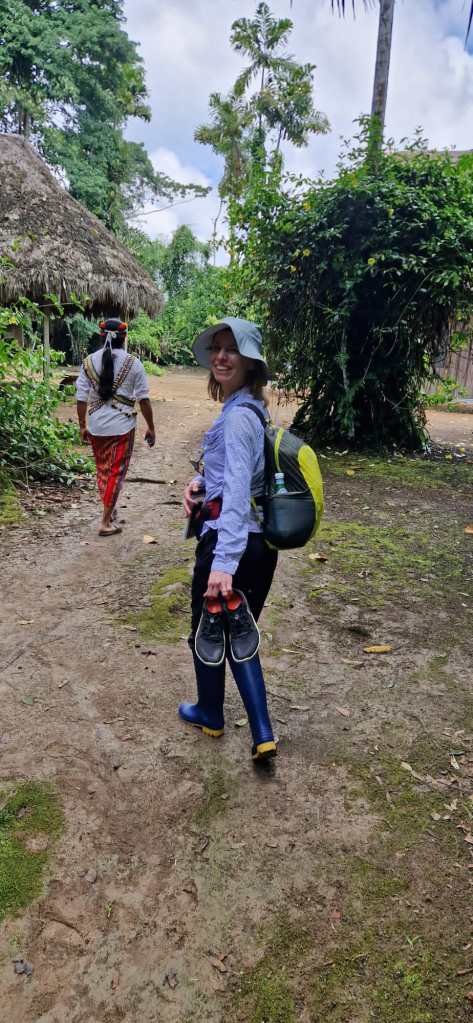
We couldn’t take more than 11kg into the forest due to weight restrictions of the small plane that took us inside, and therefore, we didn’t have space for fresh shirts for every single day of our stay. We thought we’d wash some of our clothes in the forest. Well – wrong idea!
As we later found out, the rainforest is called rainforest for a good reason. Chances are, in a place like this, your clothes may NEVER fully dry. More on this later, but suffice it to say in hindsight, I’d simply prepare for not washing clothes in the forest at all. Instead, if staying for more than 6 days, better get used to the idea of having to re-wear some shirts and trousers again, and therefore, embracing the smell of the mosquito repellents, the deodorants and essential oils, plus of course the sweat.
Back to London. Packing was a tricky part as we didn’t just go to Ecuador for the rainforest experience. We wanted to fly in early to visit the Galapagos Islands, to see some places in mainland Ecuador, before starting our organised journey into the Amazon. That meant three backpacks: one large for our international flights, and two packable backpacks – a day pack and one medium-sized bag for the jungle with max 11kg in it. We needed clothing for hot climates, clothing for high altitude (Andes), cold weather, rain and all, and overall not exceeding 20kg. Plus you also want space for some souvenirs and memorabilia to take back home.
We carefully weighed every gram of the items we bought and experimented with different space-saving travel hacks (stuffable neck pillow, anyone?).
The Journey Begins: From London to the Galapagos Islands and Beyond
Come 31st December 2023, we were ready.
On New Years’ Eve of 2023, we were on the plane, flying first to the Galapagos Islands where we celebrated the arrival of 2024. Then, off to mainland Ecuador, before starting the organised part of our journey with Fundacion Pachamama to visit settlements of the Achuar tribe deep inside the Sacred Headwaters Region of the Amazon rainforest, along the Pastaza river.
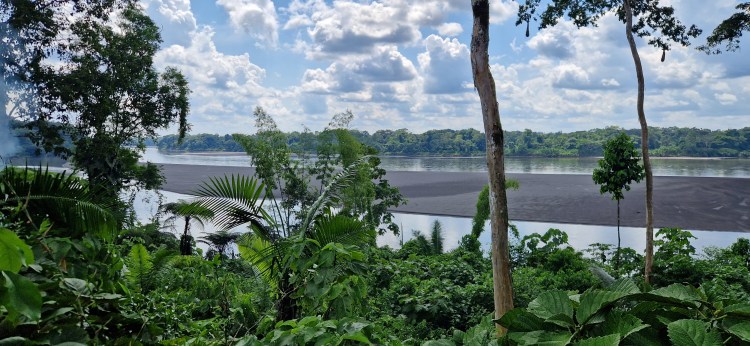
The adventure was an eye-opening and life-altering experience that 8 months in, we’re still digesting. Seeing with my very eyes how important and urgent it is to halt the destruction of the rainforest and to empower the indigenous people in their efforts to protect their land, their culture and their way of living made the trip all the more significant at this time in our world’s history.
The journey began with our commitment to it, and the preparation was an integral part of it. But our off-the-grid adventure was only just about to start.
I’ll be back with episode 2 on our journey to and arrival in Sharamentsa, a settlement nestled deep in the heart of the jungle, home to about 100 men, women, and children of the Achuar tribe.
I’ll introduce you to our hosts, their culture and language. We’ll look into the everyday life of the Achuar, their traditions and belief systems, and we’ll learn why they felt the need to open their jungle doors to visitors like us from the modern world.
But before I’m wrapping this up, a question to you
Have you ever spent time off the grid? Short or long. No phone, no conveniences as we know it. What was it like?
Please leave a note in the comments below, I’d love to read about your experience and how you prepared for the challenge.
Maketé (Achuar for ‘thank you’) for reading, Maketé for sharing and for following me on this adventure.
Love,
Gabriella
 Gabriella Ferenczi