
I read a lot. All kinds of books, mostly non-fiction. Some of them on paper, while others on Audible. Kindle or tablet – not so much, it’s just not my cup of tea. I always jot down ideas from these books in my journal, but I thought – why keep these insights to myself when I can share them here? One never knows who stumbles across these posts in the online universe and finds some nuggets to take away. It looks like that ‘one’ might be – you?!
The Bookshelf of a Curious Mind is my new series of blogs that I dedicate to exploring books and thoughts that made an impact on me as a marketer, an academic, a human being. Books that I believe have the power to shape the present and future of business, society and humanity. Ideas I don’t want to keep in my drawer but would rather share.
The first book on this virtual bookshelf is:
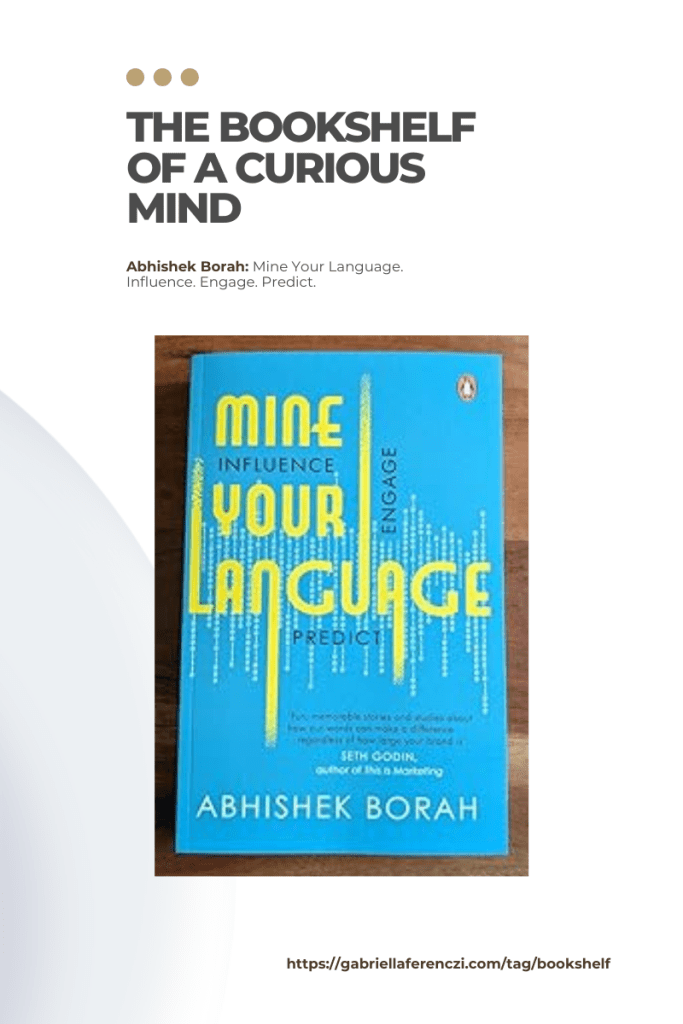
Abhishek Borah: Mine Your Language. Influence. Engage. Predict. Penguin Random House India 2024
This book is a treat for anyone interested in language’s impact on decision-making, marketing and consumer behaviour.
Ever heard of text mining?
Neither have I – until I started to develop an interest in doing research at the cross-section of marketing and linguistics. Turns out, text mining is the term for using software to analyse large amounts of text and extract useful information. Think of it like having a tool that can quickly read through tons of articles, books, or social media posts and find patterns, topics, or trends. This helps us understand common themes, sentiments, or even predict what people like customers might be interested in in the future. It’s mind-blowing.
Abhishek’s book shows exactly how text mining as a tool can be used to learn about consumers, to learn about current trends and to predict future trends. The clue is in the language we use.
Take, for example, online reviews.
You know that feeling when you read an online review and you just know that it’s fake? Ever wondered how you can tell that it’s fake? Abhishek walks you through the different linguistic markers that serve as clues.
Understanding Linguistic Profiling: How Language Reflects Identity
Linguistic profiling is something we all do, consciously or subconsciously. It is the analysis of a person’s language patterns – accent, vocabulary, grammar, speech or writing style – to make inferences about their background. This can include guesses about the person’s regional origin, social or ethnic group, or even their level of education.
Linguistic profiling can be used positively in fields like forensics and sociolinguistics to understand how language reflects identity. But it can also be controversial because, if misused, it can lead to stereotyping or discrimination.
Predicting Financial Behaviour: Language as a Credit Risk Indicator
Borah provides case studies about how lenders can read between the lines by analysing profile bios to learn more about customers and estimate how likely they are to repay a loan or default on it. In other words:
Lenders can determine your credit-worthiness not by looking at your financials, but by looking at the language you use!
How Language Can Shape Environmental Perspectives
Borah also examines how language can influence people’s views on environmental issues. He compares slogans and copy to identify which phrases inspire more action.
As this issue is way to close to my heart, let me list here just a few of his examples in the book and ask you the question:
Which of these ad slogans would inspire you most to take action?
- Please be considerate and try to stop forest fires.
- YOU need to act. YOU can stop forest fires.
- Only YOU can stop forest fires.
Read the book to find out which one was the winning formula.
This examples goes to show how important linguistic choices and nuances are to inspire people to take action, and this is precisely why I would love to do research in this area.
Language is a powerful tool that can influence behaviour, motivate change, and shape how we view the world – especially when it comes to social responsibility and urgent issues like environmental conservation.
The Power of ‘I’ vs. ‘We’ in Customer Service Communication
Another interesting section is where he explores the strategic use of ‘I’ vs. ‘we’ in customer service communication. On that note, here’s another question for you:
Which sentence would make you feel more taken care of when speaking with a customer service representative, whether on the phone or in a chat box?
‘I’ll now look into this for you.’
or
‘We’ll now look into this for you.’
Turns out, the ‘I’ is preferred by most, and Abhishek explains why in the book.
His exploration of first- and second-person perspectives in storytelling is also interesting, showing how slight language changes can make a message resonate more deeply. I used those insights to prepare for a keynote talk that I infused with a short story in the second-person singular. The trick worked!
There’s so much more in this book. Abhishek delves into topics like the perfect balance of humour, anticipation, and spontaneity on social media for engagement, and the consequences of data breaches on company trust and reputation. He also looks into the impact of swear words in online reviews, the negative effects of complex and obscure language in annual reports on a company’s bottom line; how narcissistic leaders use language, or how product recalls can also impact innocent competitors. The author also highlights how linguistic closeness within communities can benefit brands and explores the surprising upsides of vagueness in communication.
As a marketer and aspiring researcher with a background in linguistics, I found Borah’s breakdown of NLP (Natural Language Processing) and other research methods around text mining particularly interesting, though that’s the part that non-nerds would probably want to skip.
At times, the author’s language veers toward the academic side; for example, with the frequent use of ‘thus,’ which I admit might be one of my personal pet peeves. But overall, the writing is clear and accessible, and Borah goes to great lengths to try to simplify complex ideas, making the content perfectly approachable for readers in or outside academia. He infuses the text with bits of humour and light-heartedness which is refreshing especially in a topic that could otherwise feel dense or overly technical.
It’s a rewarding read for anyone wanting to learn more about the power of language in influencing people. I particularly enjoyed the personal anecdotes, and Borah’s music references were the cherry on top. I’m telling you, his taste is spot on!
Your Thoughts: How Language Shapes Our Consumer Journeys
If you’ve read Abhishek’s book or have thoughts on these ideas as a consumer or have something to share from the point of view of business, I’d love to hear from you in the comments below. Let’s keep the conversation going.
Love,
Gabriella
 Gabriella Ferenczi