
On April 12th 2026, Hungary ousted Prime Minister Orbán and with that, a 16-year old chapter is closing in Hungary’s history. In this 4-part series, I’m reflecting on how I saw what just happened in Hungary. I’m looking at it from a marketing and communications perspective, and as a linguist, trying to decode what enabled Orbán to stay in power for so long. In the final post, I’ll turn to the question of restitution. That’s a difficult conversation, and one that inevitably brings up uncomfortable historical parallels.
Part 1: What just happened in Hungary
Part 2: Two realities: Political marketing in parallel worlds
Part 3: When language becomes a weapon (you are here)
Part 4: The banality of silence
In my previous posts, I wrote about what the night of the election felt like. Then, I looked at the mechanics behind how political marketing created two parallel realities where ultimately, truth won.
This time, I want to address what I saw as a linguist, as I find it impossible to switch that part of my brain off when observing the world around me.
Words are never just words. They carry tone, intention, history. They reveal more than they say, and sometimes, they hide more than they reveal.
Words are not just describing reality. They are shaping it. And eventually, in Hungary, they started dividing it.
Here are a few peculiarities that I found alarming, interesting, funny, hilarious – and incredibly creative.
Language as a tool of division
One of the most visible shifts was in the way people were labelled.
Take the word libsi.
On the surface, it’s just a shortened form. A casual, almost playful version of liberális, meaning ‘liberal’. But in practice, it became something else entirely. Dismissive. Condescending. A way to reduce a person – their views, their identity – into something that no longer needed to be taken seriously.
Once the label is applied, the conversation is over. You’re no longer engaging with an argument. You’re responding to a category.
I would never have thought that one day, I would be classed as a ‘libsi’ and that would mean something pejorative. But according to Fidesz (Orbán’s party), I should be ashamed of myself for being an open-minded liberal (who, just for the record, also appreciates both conservative and leftist values).
Language creates these categories quickly. And once they exist, they are very difficult to step out of.
Language as ridicule and erosion
At the same time, another layer started to emerge: Humour. Or perhaps more accurately, mockery.
Words like NERflix, NER-lovag, PusztaVersailles, or even FideSS started circulating widely. Clever. At times genuinely funny. Often painfully accurate in what they were pointing to.
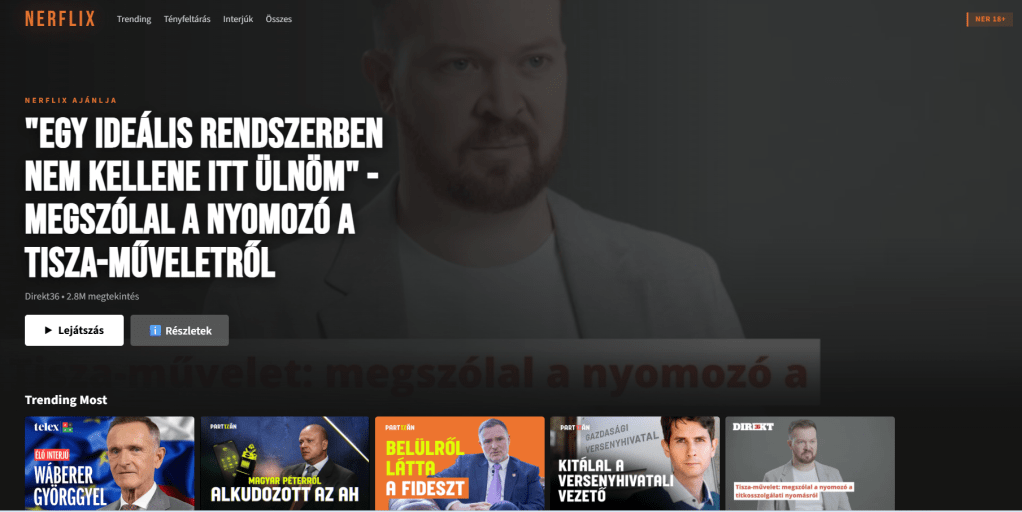
NERflix plays on Netflix, but replaces it with NER, short for Nemzeti Együttműködés Rendszere (“System of National Cooperation”), the official name of the Orbán-era political system that favoured cronies.
NERflix played on Netflix of course, but it became something much more than a joke. It referred to a wave of long-form whistleblower interviews and conversations – people who had once served within the system coming forward to share what they had seen. Stories from the army, from political institutions, from behind the scenes of power.
They were gripping. Almost cinematic.
People found themselves glued to their screens in the evenings, following one story after another. There was a running joke online that Netflix subscriptions had become redundant, there was simply no time for fiction anymore. Reality was a lot more interesting.
At some point, even a website appeared under the name NERflix, collecting these interviews, these “episodes” of a system slowly being exposed from within.
There were other expressions built around NER, such as NER-lovag (“NER knight”). It became shorthand for individuals who rose to prominence and wealth through close ties to the regime, often benefiting from large government contracts and public funds.
Then, one of my favourites: PusztaVersailles. It refers to Hatvanpuszta, a rural estate linked to Győző Orbán, Viktor’s father. Puszta evokes the Hungarian countryside (a kind of grassland steppe), while Versailles suggests excess, luxury, distance from ordinary life. The contrast does the work.
FideSS is a simple but loaded twist on Fidesz, inserting “SS” – a historical reference that doesn’t need much unpacking to carry weight.
Humour became a way of coping. Of resisting. Of making sense of something that, at times, felt totally absurd. And of course, there was something deeply creative about it too.
When language turns hostile
Up until a certain point, much of this could still be seen as creative, even if at times uncomfortable.
But there is a line. And in Hungary, that line was crossed in my view.
Expressions like O1G started as internet shorthand – a coded way of expressing anger towards Viktor Orbán. G stands for a really vulgar word, it’s an expletive, essentially saying that ‘Orban is a …..’ – use the most insulting word you can think of. O1G circulated widely online, in comments, and became part of a kind of digital folklore.
It wasn’t polite, no. But it stayed, for the most part, within a certain cultural space.
What was more striking was when political actors themselves started adopting and adapting this language.
Z1G appeared during the campaign, introduced by János Lázár, Minister for Transportation. Z1G is mirrored version of O1G. An escalation. Z standing for Zelensky. Coming from – a – minister – in – public – office.
Now, that felt different.
Because when this kind of language moves from the margins into official political discourse, something shifts: It legitimises hostility. It lowers the threshold. It signals that this is now acceptable – not just whispered, but openly used. Not the correct move in any shape or form.
Blended words
Take expressions like Gyurbán, Orcsány, or Viktátor.
Ferenc Gyurcsány, who preceded Orbán as prime minister, was once positioned as his greatest adversary. Merging their names collapses that distinction, suggesting they are in fact one and the same: representatives of an old system that needs to be dismantled, a central message of Péter Magyar.
Viktátor adds another layer, merging “Viktor” with “dictator”. No argument or explanation needed. The judgment is already embedded.
Invented worlds: when naming reshapes reality
Then there are words like Orbánia and Orbánisztán. A country turned into a personal domain. Hungary reframed as belonging to one man.
Or luxizni, a new verb derived from “luxury”, used to describe a certain lifestyle associated with political elites. Not just wealth, but a kind of performative consumption.
Rhythm and repetition: when language becomes chant
And then there are expressions that move beyond meaning altogether.
Bilincs, bilincs, rács, rács.
(Handcuffs, handcuffs, bars, bars.)
Repeated. Chanted. Often paired with emojis. It’s about rhythm. Emotion. And a kind of collective wish for accountability.
Movement metaphors: when behaviour becomes imagery
Some words work through imagery.
Angolnázni – to move like an eel. Again, a word I’ve never heard before. To slip, to shift, to change position depending on the situation.
It’s vivid and instantly understandable.
Borrowed language: when English enters the system
Then there is endorszálni, and adresszálni.
A Hungarianised version of the English “to endorse” and, you guessed right, “to address”. Slightly awkward and forced, but widely used. Think of Donald Trump endorsing Viktor Orbán, or when a certain problem has to be addressed. I’ve never seen these English words being used by Hungarians, before this political campaign.
A nod to Ádám Nádasdy
Ádám Nádasdy was one of Hungary’s most respected linguists, a prominent translator and poet who specialised in English linguistics, and German historical linguistics. He taught English at my alma mater while I was studying Germanistik there, and while he worked at a different school, we were part of the same intellectual world.
Later, he moved to London. In that sense, too, our paths are not entirely different.
I read his Londoni levelek ‘Letters from London’, a collection of reflections from life in London, and gifted it to my mum.
I was fortunate to see him last year in my hometown in Hungary, when he came to promote his book. He was, as always, thoughtful and quietly humorous.
He passed away just before the election, so he didn’t get to cast his vote at the 2026 elections and see the results, but have no doubt – his vote would have been another big NO to the Orbán regime.
May he rest in peace.
Other posts in the series

The red line: advertising, propaganda, and moral responsibility
Where is the line between political communication and psychological manipulation? This post explores the role of Hungary’s advertising industry during the Orbán era, examining propaganda, fear-based campaigns, public money, and the ethical responsibility of creatives and agencies.

The banality of silence | What just happened in Hungary
How did silence become part of the system? This post explores media control, quiet complicity, and the difficult questions Hungary now faces as people begin to speak.

Two realities: Political marketing in parallel worlds | What just happened in Hungary
How do you build an alternate reality? This post looks at the communication strategies, media ecosystems, and narratives that allowed two versions of truth to coexist in Hungary.


3 comments