

This post is loosely connected to my recent 4-part series on Hungary’s political transition, but this time, I want to focus on the advertising industry during the Orbán era between 2010 and 2026.
Because at some point, we have to ask the question:
Where is the red line?
Where is the line between persuasion and manipulation? Between campaigning and psychological pressure? Between strategic communication and propaganda? Between doing your job professionally and participating in something that causes real social harm?
Those questions became impossible for me to ignore while watching Hungary over the past decade and a half.
A billboard next to a school
One of the things that will stay with me from the Orbán years is the visual landscape of Hungary.
Billboards everywhere.
At times, it genuinely felt impossible to escape politics in public space. You would walk down the street, drive on the motorway, wait at a bus stop, and there it was again. The key messages:
Threats. Enemies. War. Fear. Only FIDESZ (Orbán’s party) can save you.
Some of these campaign visuals appeared near schools. Children walked past them every single day. Posters implying war and destruction. Messages designed to trigger anxiety.
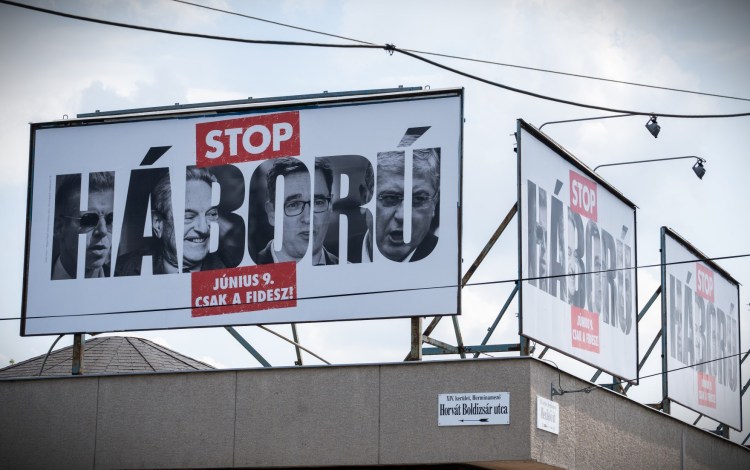
Context: European Parliamentary Elections 2025
Faces behind the letters: Péter Magyar (now Prime Minister of Hungary), George Soros (Hungarian-American investor and philanthropist), Gergely Karácsony (mayor of Budapest), Ferenc Gyurcsány (Prime Minister of Hungary 2004-2009).
The central questions I want to explore are these:
At what point does advertising stop informing and start psychologically harming people?
And what responsibility do marketers, creatives, strategists, and agencies carry for the systems they help shape?
Public communication as a privilege
Government communication should be one of the greatest privileges in the advertising profession.
Tourism campaigns. Educational initiatives. Public health messaging. Environmental awareness. Culture. Public service information that genuinely improves people’s lives.
Communication that informs, educates and inspires positive action.
Political marketing is, of course, a specialised field within the wider advertising and communications industry. Campaigns during election times are designed to persuade, mobilise emotion, and energise supporters. That in itself is not unethical. Democracies depend on competing visions, narratives, and persuasion.
But there is a line between persuasion and manipulation.
And in my view, Orbán’s campaigns crossed that line many times.
Enormous amounts of public money were poured into campaigns built on fearmongering, division, ridicule, and psychological pressure. And this is where I think the advertising industry in Hungary has some very uncomfortable questions to ask itself.
Enter Gyula Balásy
Gyula Balásy became one of the most influential behind-the-scenes figures of this era through his marketing agency group and its dominance in government communication.
For years, his companies managed enormous state advertising budgets and operated in what many industry professionals now describe as a distorted, heavily centralised market.
The allegations are serious:
- massively overpriced contracts
- monopolistic positioning
- state-funded market distortion
- agencies winning work through political proximity
Industry experts now openly speak about the need for a “cleansing” of the profession. Transparency. Accountability. A full reckoning with what happened.
Balásy himself appeared in an interview in the first week of May, before the new prime minister had even been sworn in, offering his companies (together with their assets and personnel) to the state.
He tried to frame this as a generous gesture. Almost as a form of restitution after years of profiting immensely from serving FIDESZ (Orbán’s party) and government propaganda so diligently.
But there was an obvious problem with this narrative.
A company whose main client was the state suddenly found itself financially troubled the moment the political system collapsed. In other words, what was being offered to the state was, in reality, a business model that no longer functioned, and therefore, effectively, companies that had become close to worthless overnight.
Many interpreted this not as accountability, but as an attempt to transfer further burden onto taxpayers.
“We were just doing our job”
What fascinates me most is not even the entrepreneur and marketing agent Balásy, but more the ecosystem around him. Because systems like this do not operate through one mastermind sitting in a dark room.
They operate through layers of normalisation. Through marketing professionals convincing themselves that they are “just doing communication”.
The designer creates the visual.
The copywriter writes the line.
The strategist approves the campaign.
The media planner places the billboard.
The executive signs the contract.
A jury later hands out industry awards.
And somewhere along the way, responsibility magically dissolves.
Creativity without ethics
As someone who has worked in marketing and communications and now teaches marketing at a university, I find this particularly painful to watch.
Because marketing is a serious responsibility. Storytelling is powerful. And advertising can shape public emotion, public space, and public psychology.
Fear appeals in communication are not new. Political messaging has always used emotion. But there is a line between persuasion and psychological manipulation.
And over time, Orbán’s party crossed it repeatedly.
Here is one of the most notoriously manipulative campaign videos of the late Orbán era, a piece of political advertising that many Hungarians found psychologically disturbing. You do not need to speak Hungarian to understand what it is trying to do emotionally, but for context, the child asks:
“Mummy, when is daddy coming home? … But where is he now? … When can I see him again?”
To which the mother replies, tears in her eyes:
“Soon.”
The closing message then states:
“War takes away something from everyone. Let’s not risk it. FIDESZ is the safe choice.”
Watch until 1:06 – the rest of the clip is just a reflection on this fearmongering technique, in Hungarian, reported by one of the few remaining Hungarian TV channels that continued to broadcast government-critical news.
The industry knew
One of the recurring arguments now is that people working on state advertising and propaganda “had no choice”.
I understand that reality is rarely black and white. People have mortgages, children, careers, and responsibilities. But I also think we need to be honest:
The marketing professionals working on these campaigns understood perfectly well what they were producing.
They knew when billboards were misleading.
They knew when statistics were manipulated.
They knew when fear was being weaponised.
And many still participated. Not necessarily because they were ideologues.
Sometimes because of money.
Sometimes because of ambition.
Sometimes because remaining silent felt easier.
That’s the banality of evil, as Hannah Arendt described it back in 1963 after the Nuremberg trials – a concept I touched on in my previous post as well, about Hungary’s media system. Arendt’s central insight was that oppressive systems are often maintained not by obvious villains, but by ordinary people quietly doing their jobs and convincing themselves they bear no real responsibility.
The Banality of Evil
Hannah Arendt developed the idea of the “banality of evil” in the early 1960s while reporting on the trial of Adolf Eichmann in Jerusalem. Her reflections were first published as a series of articles in The New Yorker in 1963, and later that same year in her book Eichmann in Jerusalem: A Report on the Banality of Evil.
The central idea was controversial because Arendt argued that Eichmann did not appear as a monstrous fanatic but rather as an ordinary bureaucrat who stopped thinking critically about the consequences of his actions and simply complied with the system around him.
Adolf Eichmann was a high-ranking Nazi official who played a central role in organising the logistics of the Holocaust, including the deportation of Jews to ghettos and extermination camps, particularly from Hungary.
Fear as a visual language
Looking back, what strikes me is how emotionally exhausting the visual environment became. Politics moved into every corner of life. You could not opt out. And the aesthetics themselves became harsher over time:
- enemies
- threats
- war
- humiliation
- suspicion
Repeated endlessly. A country psychologically saturated with anxiety.
Where do we go from here?
Now that the Orbán regime has collapsed, Hungary’s advertising and communications industry faces a reckoning of its own.
Should agencies disclose about past state contracts?
What level of transparency is needed?
Where should accountability begin and end?
Can marketing and communications professionals regain trust after becoming so deeply entangled with propaganda?
Should these marketers be offered work in the future?
Should there be an apology?
These are not simple questions. But avoiding them would be a mistake.
Political marketing and persuasion
Political communication will always involve persuasion. Campaigns are meant to convince, mobilise, and energise supporters. That is not the problem.
The problem is what persuasion becomes when fear, manipulation, and psychological pressure replace honest political debate.
Because in Hungary, enormous amounts of talent, creativity, money, and infrastructure were ultimately used not to inform or engage citizens, but to keep them anxious and to spread fear.
That, to me, is the real tragedy.
And perhaps this is the real reminder here, for marketers, communicators, creatives, but ultimately for all of us, to occasionally stop and ask:
What exactly am I contributing to the world through my work?
What am I encouraging in people?
And who benefits from it?
The world already contains enough noise, manipulation, fear, and meaningless consumption.
That is why ethical responsibility matters so much.
So, whatever industry we work in, let us all try to zoom out and never lose sight of the bigger picture.

